A Unique Institution
The Universal House of Justice is unique in religious history. Never before has a Manifestation of God explicitly ordained the establishment of an institution mandated to preserve the integrity and flexibility of His religion, safeguard the unity and guide the activities of His followers, and exert a beneficial influence on the life of society.
By virtue of the authority invested in it by Baháʼuʼlláh, the Universal House of Justice stands at the head of an administrative order whose features, authority and mode of functioning are clearly set out in the Sacred Writings. The work of this order is characterized by an ethos of loving service — focused on the development of human potential and the advancement of civilization.
Baháʼuʼlláh conferred upon it the authority to exert a positive influence on the welfare of humankind, to promote education, peace and global prosperity, and to safeguard human honour and the position of religion itself.
Powers and Duties
The members of the Universal House of Justice are described in the Sacred Writings as “Trustees of God among His servants” and “daysprings of authority in His countries” — shepherds to His flock, charged with protecting the unity and well-being of Baháʼuʼlláh’s followers.
Its duties reach far beyond the community itself: the training of peoples, the upbuilding of nations, the protection of every human being and the safeguarding of their honour. The promotion of world peace stands among its responsibilities, as does safeguarding the position of religion and exalting its station before the world.
Because “change is a necessary quality and an essential attribute of this world,” Baháʼuʼlláh empowered it to legislate on matters He did not specifically address — while its decisions, the Writings assure, are made through the inspiration and confirmation of the Holy Spirit.
Origins
Baháʼuʼlláh ordained the institution in the Kitáb-i-Aqdas; ʻAbduʼl-Bahá confirmed its authority in His Will and Testament and laid down the details of its establishment and functioning. Shoghi Effendi then devoted more than three decades to preparing the community for its election — every new National Spiritual Assembly became, in his words, one more pillar “to share in sustaining the weight” of the House of Justice.
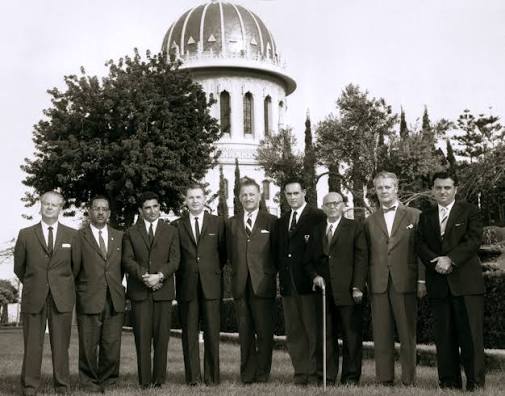
In 1951 he appointed an International Baháʼí Council as a forerunner; in 1961 that Council became an elected body chosen by all National Assemblies. After the Guardian’s sudden passing in 1957, the Hands of the Cause of God whom he had appointed faithfully carried his work forward and arranged the first election.
In April 1963 — the centenary of Baháʼuʼlláh’s public declaration — the Universal House of Justice was elected by the 56 National Spiritual Assemblies then existing in the world. Through a democratic global process spanning more than a century of growth, the community had brought into being the permanent institution ordained to guide its affairs.
The Electoral Process
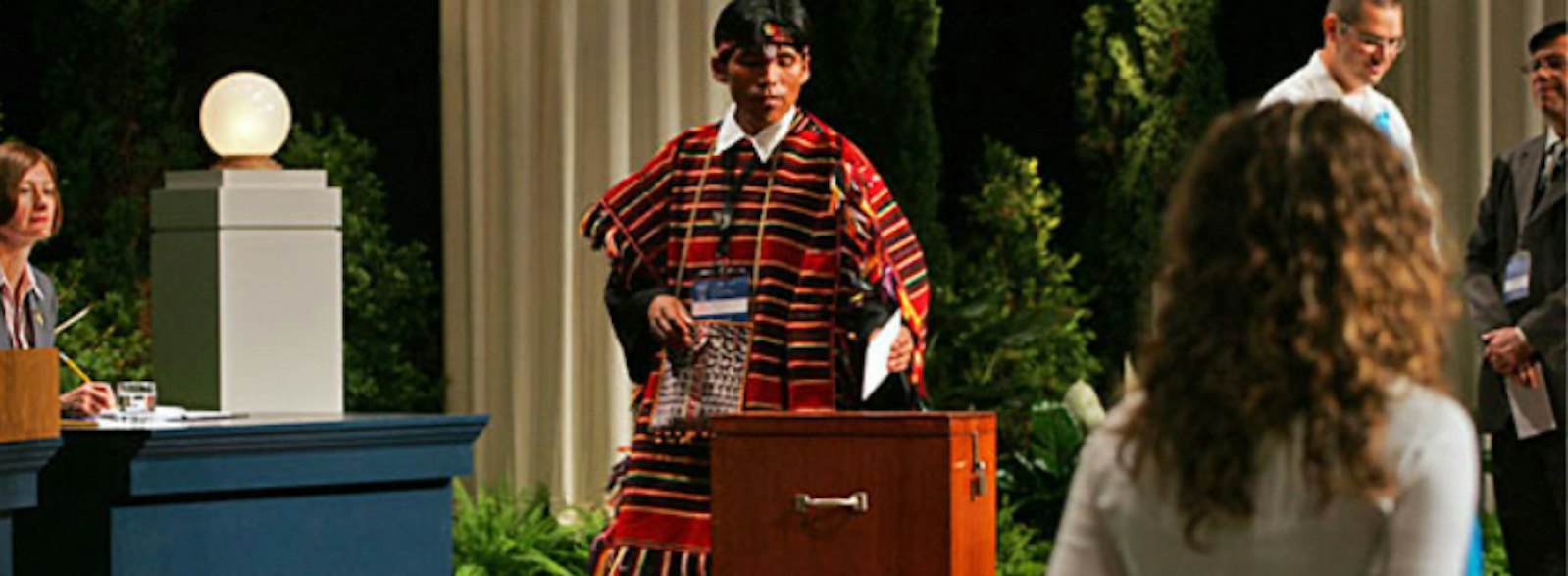
The Universal House of Justice is elected through a three-stage process. In every national community, adult Baháʼís gather annually in unit conventions to vote by secret ballot for delegates; those delegates then elect the nine members of the National Spiritual Assembly.
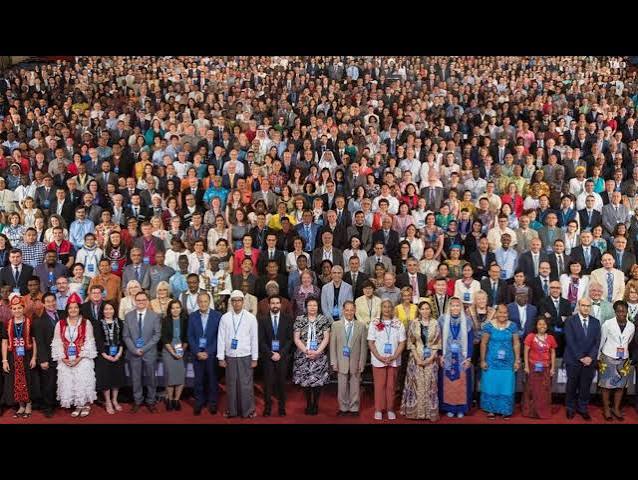
Every five years, the members of all National Spiritual Assemblies gather at the International Baháʼí Convention in Haifa to elect the nine members of the Universal House of Justice. In common with all Baháʼí elections, the process is entirely free of nominations, electioneering, canvassing and propaganda — voters are guided solely by prayer and the qualities described in the Writings: “daysprings of knowledge and understanding,” “steadfast in God’s faith,” “well-wishers of all mankind.” Membership of the House of Justice is confined to men — a provision ordained by Baháʼuʼlláh Himself, whose wisdom, ʻAbduʼl-Bahá stated, will become clear in the future. It can in no way be read as a sign of superiority, for the equality of women and men is an “established fact” in the Teachings.
The Seat on Mount Carmel
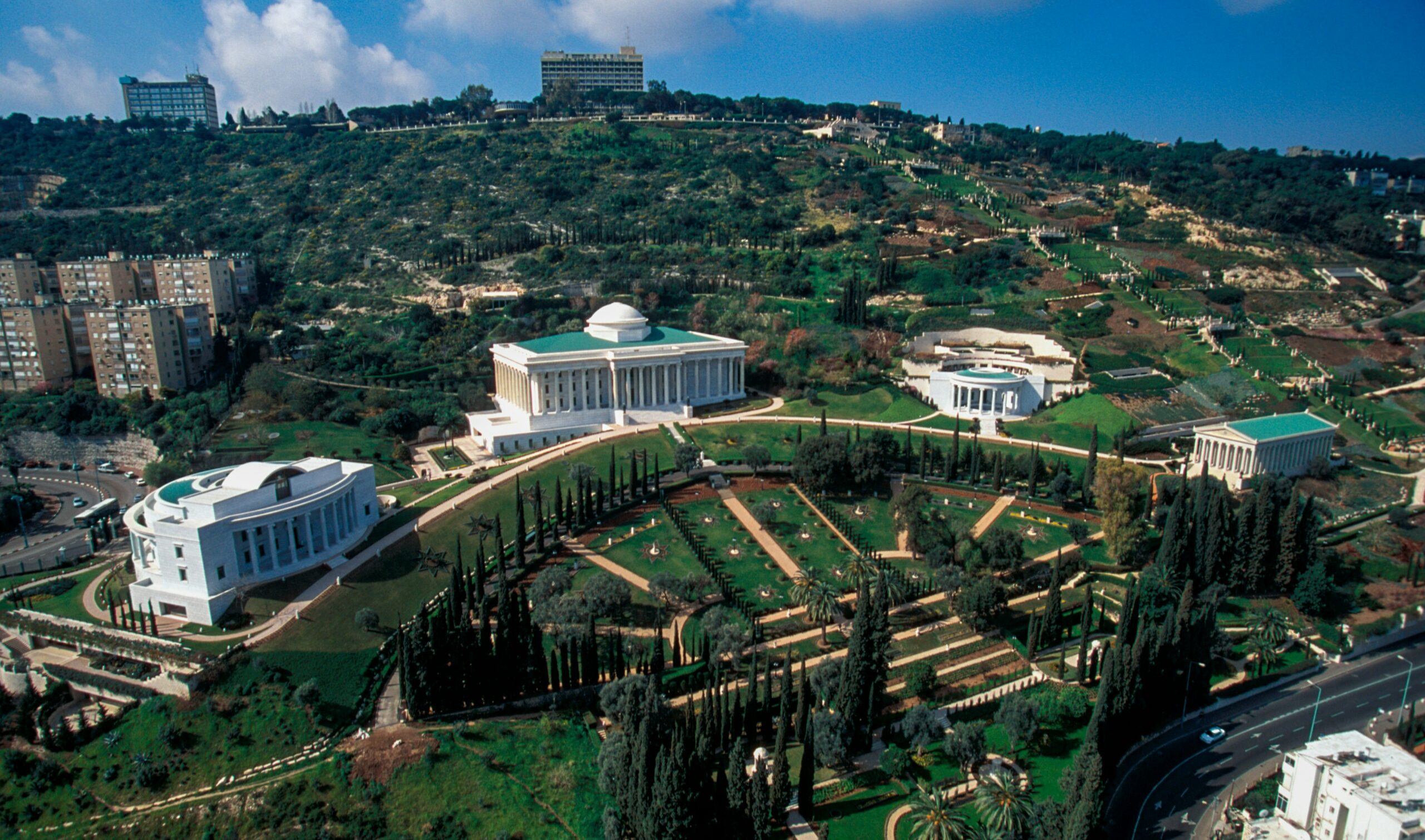
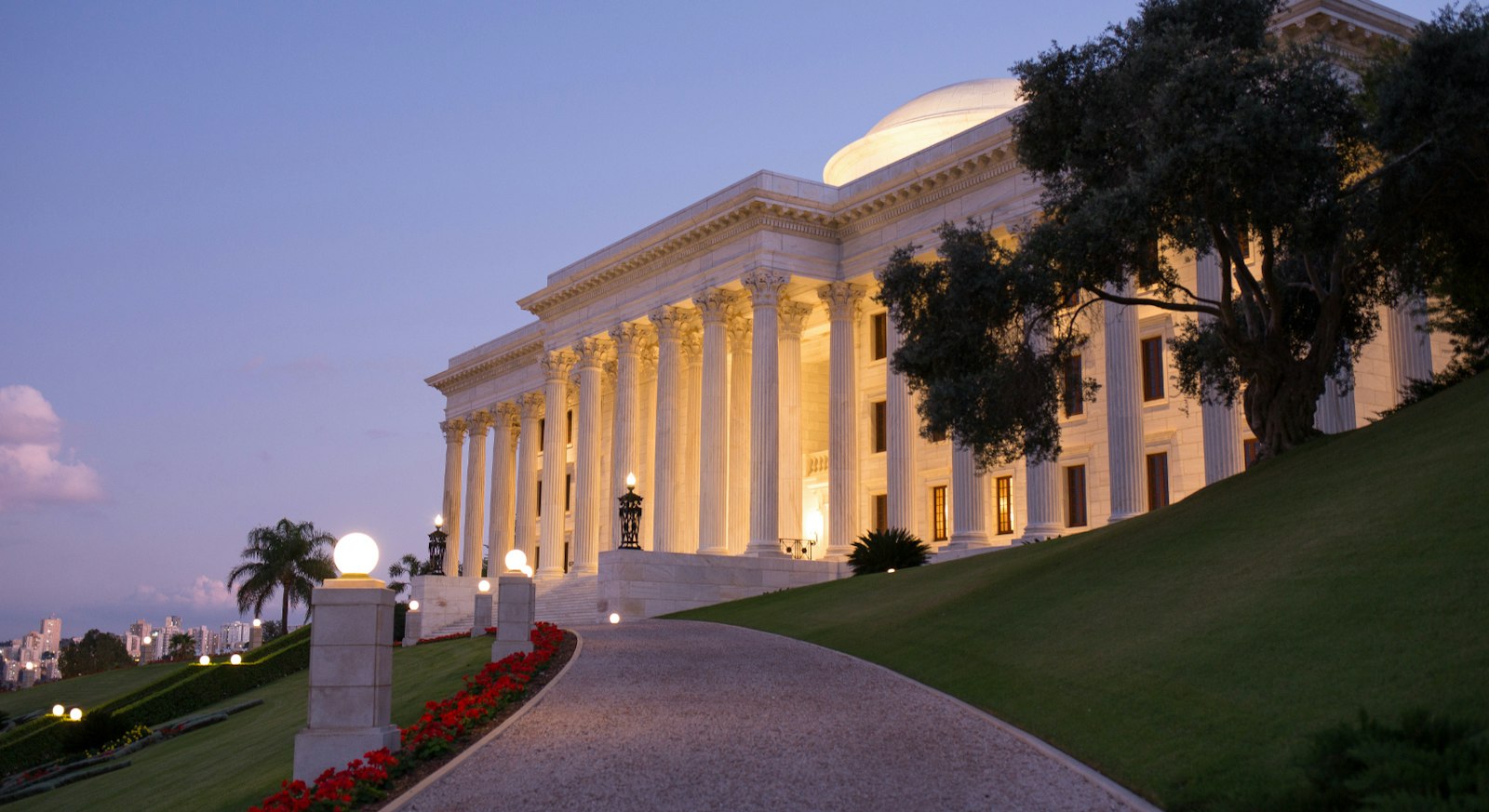
Shoghi Effendi had mapped an arc on the slope of Mount Carmel — near the Shrine of the Báb — around which the buildings of the Faith’s world administrative centre would stand. In June 1975 the Universal House of Justice announced that the time had come to build its own permanent Seat, and the building was completed and occupied in 1983.
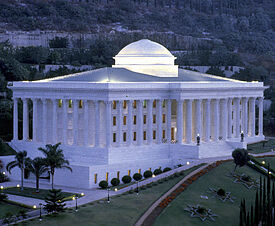
The Seat stands at the apex of the Arc, with the International Teaching Centre building on one side and the Centre for the Study of the Texts and the International Archives on the other. Following the harmonizing classical style the Guardian had established, the stately Corinthian order was adopted: tall fluted columns surround the building, a portico of six columns marks the entrance, and a dome crowns the Council Chamber at its heart — a window facing toward the Shrine of Baháʼuʼlláh.
Inside are the Council Chamber where the House of Justice meets, a reception hall for pilgrims and distinguished visitors, a conference room, and the offices of its secretariat.
Guiding a World Community
Since 1963 the Universal House of Justice has devoted itself to building a community with the resources and capabilities to participate in establishing the global civilization envisioned by Baháʼuʼlláh. Through a series of global plans it has guided the Faith’s expansion, learning, and involvement in the life of society.
Its regular messages — above all the annual Ridván letter to the Baháʼís of the world — set the direction of the community’s endeavours and ensure unity of thought and action across every land.
To support its work it has created appointed institutions, among them the Continental Boards of Counsellors and the International Teaching Centre. Together with the elected councils of the administrative order, they form a system through which the Baháʼí community learns, grows and serves — on every continent, including here in Tanzania.